
Pipeline Monitoring using EREBOS
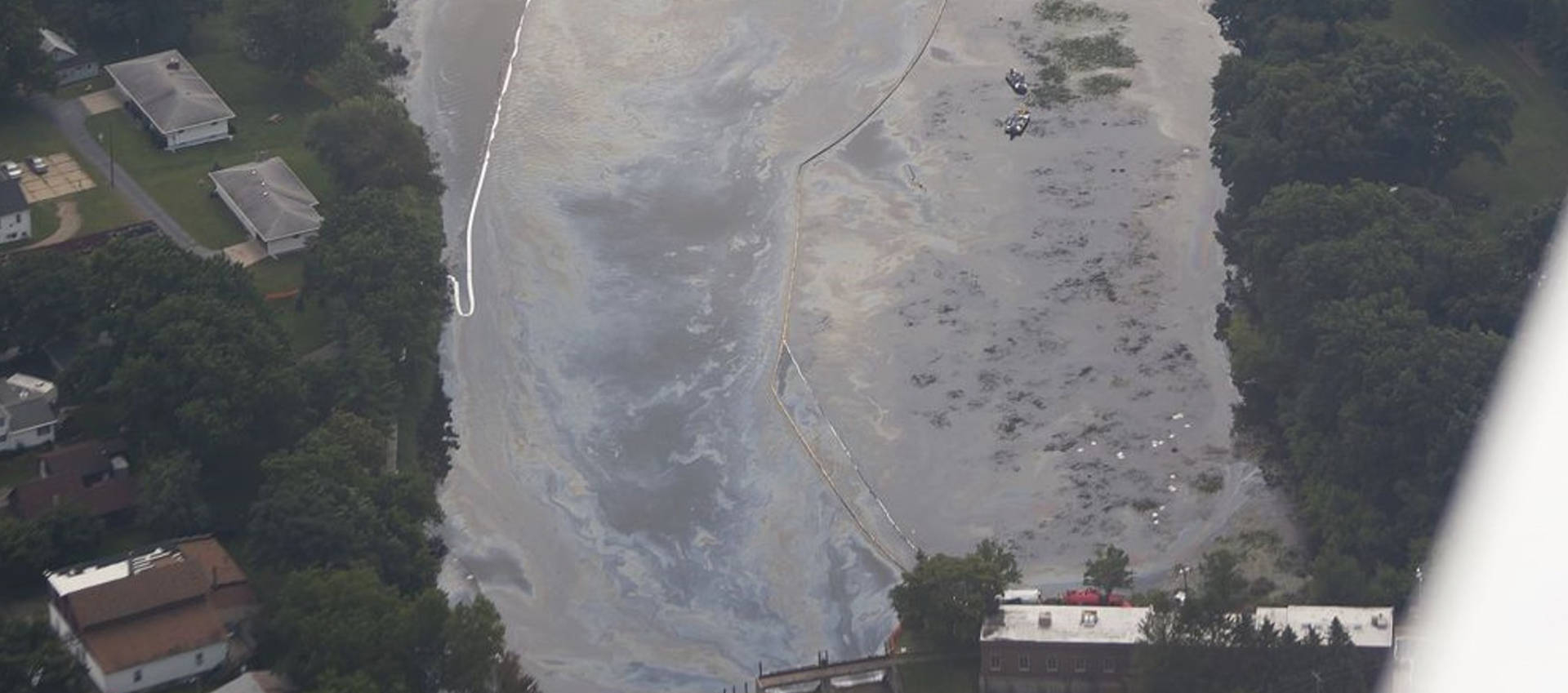
In 2010, an oil spill occurred in Marshall, Michigan with a total release of approx. 843,444 gallons of oil.
It was a combination of instrumentation and operator error that allowed over 80% of the total pill to occur after the initial rupture.
The pipeline was restarted twice, spilling an extra 683,436 gallons of oil, before finally being turned off approximately 17 hours after the first spill.
The estimated cost to date to remediate the effects of the spill have totalled approximately $767 million dollars (US).
Cracking due to external corrosion was observed by NTSB during their investigation; the outer wall of the pipeline had corroded, likely caused by a wrinkled coating which nullified the cathodic protection for that area of the pipe.
DARKPULSE SOLUTION
Supposing EREBOS™ had been installed on the pipeline as in figure 2 the initial cracking would have caused higher wall stress. The stress would be measured as an increase in the hoop strain of the pipe for the affected segment. This increase in strain would be observable over different operating pressures, and would indicate a weakened section of pipe. The section of pipe can then be repaired by conventional means and a new piece of fibre can be installed at the affected site. Alternatively, if only leak detection is required, a single fibre buried axially to the pipeline can be installed. This fibre can be heated externally (like a hot-wire anemometer), and when a leak occurs a temperature drop would be
measured in the fibre.
Supposing, however, the initial fatigue of the wall went unnoticed and the fibre was wrapped helically, when the rupture occurred the fibre would have broken, causing a worst case scenario alarm to be triggered (lack of signal). This alarm can only occur when the fibre is broken, and the operators would know instantaneously that the pipeline has ruptured. With
EREBOSTM, there would most likely have been no spillage, or as a worst case scenario the extra 683,436 gallons of oil would not have been spilled.
The estimated cost of a DarkPulse based EREBOS™ system is minimal when compared to the clean-up costs associated with oil spills.
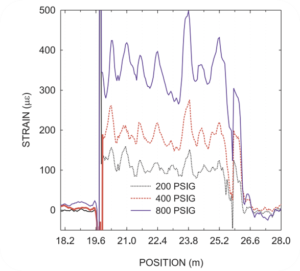
Data gathered around the pipe using a dark pulse based system with 25 cm spatial resolution. Note the periodic increases in strain demonstrating the detection of
the pitting.
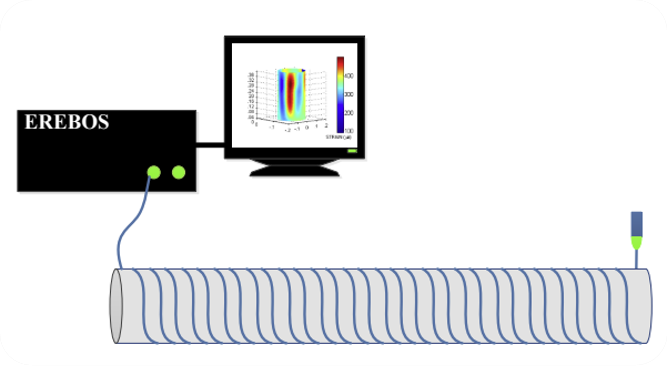
EREBOS™ monitoring a pipeline that has been helically wrapped with fibre.